Audit trail review
We made answering complex questions about clinical trial data as simple as having a conversation.
The problem
Audit trails contain essential forensic evidence about how clinical trial data is created, changed, queried, and reviewed. Clinical practitioners, CROs, and drug sponsors regularly receive questions from auditors at the FDA that require answers to these questions.
Before our intervention, retrieving and reviewing this data was unsustainable. It took weeks, multiple teams, and manual processes to look through files without any real assurance of accuracy. This cognitive fatigue prevented clinical data management teams from focusing their attention where it was actually needed; driving forward the best outcomes and treatments for patients.
An experimentation approach
To find the most natural layout and interaction model, we used an active experimentation process. We conducted interviews and contextual inquiries with Clinical Research Associates, Data Managers, and internal subject matter experts (namely Implementation Consultants who provide professional services for clients) to explore how they interact with audit data.
We designed and tested multiple options to learn what reduced their cognitive load and gave them the greatest confidence. This user testing yielded key design requirements:
Guided entry points
Users felt lost when presented with a blank search box. They requested prompt templates and structured starting points to begin their analysis confidently.
Clear layout division
Users needed a clear separation between the conversational helper and the raw clinical data tables so they could easily read forensic evidence.
The helper role
We learned that AI/ML must act as a smart helper rather than a black box. Users must remain in control of the final compliance decisions and the system needed to ensure users could trust what was being presented back to them.
One click reports
The primary user goal is translating complex analysis into a formatted record. Building a single click export was critical to saving review time.
Design evolution
Exploration and user feedback
Early concepts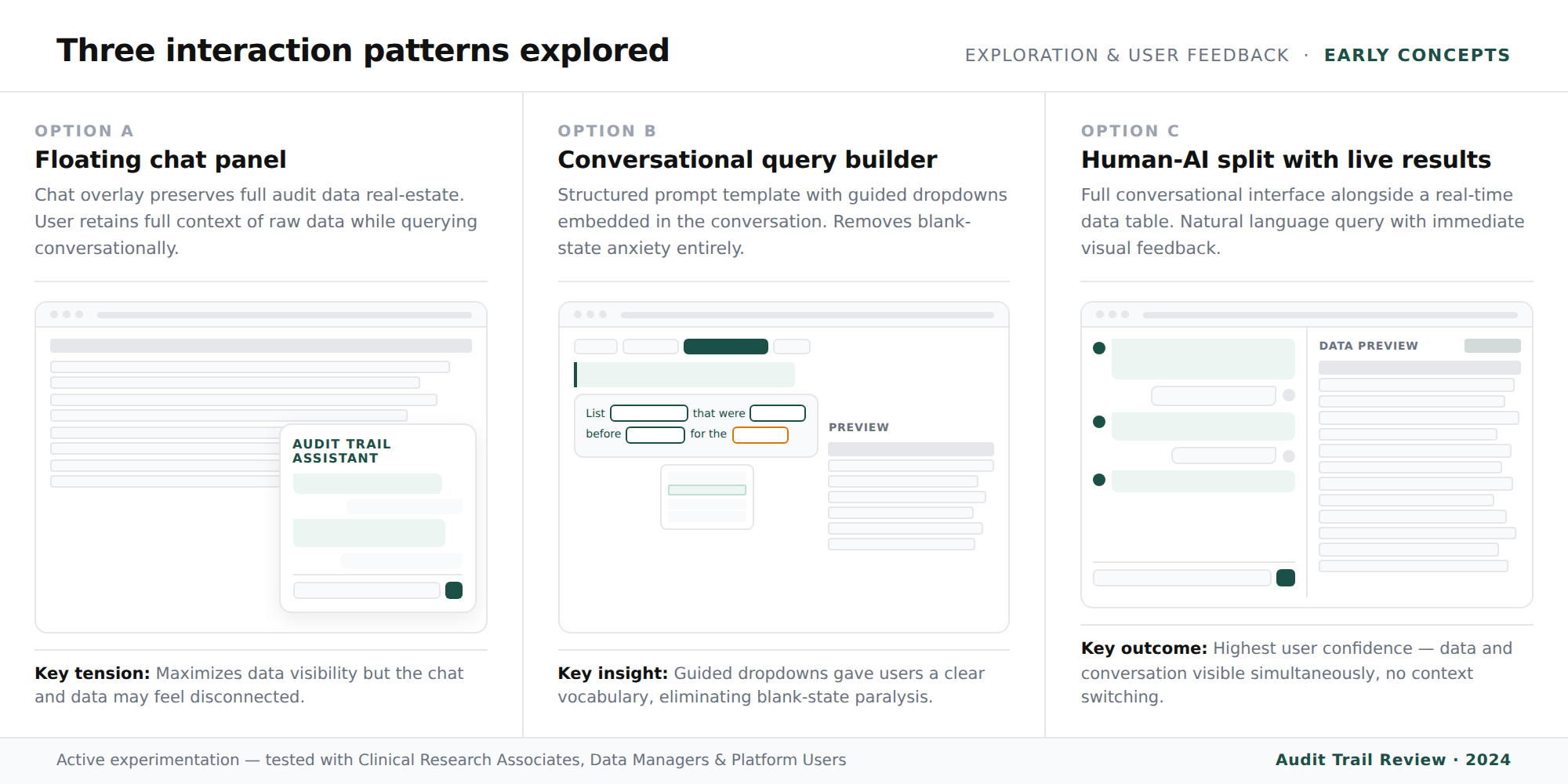
Minimum viable product
Released versionIdealized experience
Future visionMeasurable outcomes
Time saving
Reduced audit review time from weeks and multiple teams to a matter of days for a single person.
Confidence
Users report increased consistency and confidence in reviews across clinical research sites.
Regulatory readiness
Improved regulatory readiness and responsiveness for platform users.
AI integration
Thoughtful integration of machine learning that supports, rather than replaces, human judgment.
Signal detection
Earlier identification of unusual patterns, high risk sites, and data quality issues.
Reporting
Single click output of audit data formatted clearly for external auditors.
The team
- Kayce Reed-Buechlein
Lead Designer - Simone Betito
Senior Product Designer - Marouane Nouira
Vice President, AI/ML - Katy Ghantous
Senior Director of Data Science - Lichen Shen
Senior Director of Product Management